The essential question asked to us this week was, How were the results of the Election of 1860 representative of the deep divisions over slavery? This answer has many aspects one being that when Lincoln became president the southern states who were not in favor of his presidency felt the urge to leave the union. We looked at many pieces of art from the civil war which also helped show the election of 1860 and secession. Check out the art in my group's Educreations video!
Tuesday, March 17, 2015

Tuesday, March 10, 2015
Union vs Confederacy
We have been learning about the events leading up to the civil war in class recently.After viewing many documents and statistics it became evident that the North would win the war. Though the south had many advantages such as trained military personnel, a large slave population for fighting, and a good income due to trade, the advantages the North had out weighed those of the South. For this reason I set up my info graphic based on Northern advantages. My project displays a variety of interesting important data to prove that the North was truly on top during the Civil War.
Monday, March 2, 2015
Elephant in the Room
Slavery, an uneasy topic for many, has proven to be the elephant in the room for 19th century politics. By creating a timeline of events that led up to the civil war in class this week we learned a lot about how slavery was the elephant in the room. This means that slavery was a major issue that people avoided having discussions about. Though Politicians in the 19th century did have meetings like the one at which the Compromise of 1850 was declared, people tried to avoid talking about slavery. They took action for whichever side they supported, either anti or pro slavery. Events such as Bleeding Kanas, The Canning of Charles Sumner, and John Brown's Raid all ended in violence simply because slavery was the elephant in the room and no one wanted to talk about it.

 |
| Henry Clay |
Slavery, being the elephant in the room, caused the violent actions were refer to as Bleeding Kansas. This is a few events grouped together in a broader unit. Some of these events include the burning of Lawrence and the massacre at Pottawatomie Creek. Lawrence Kansas, home to a popular newspaper, was burned on May 21, 1856 by a pro slavery mob. There goal was to prohibit the spread of anti slavery by word. Three days later, John Brown massacred many men at Pottawatomie Creek. All this violence was a result of people not wanting to sit down and discuss the obvious issue at hand.
The Canning of Charles Sumner is the next violent outbreak that occurred. Charles Sumner was the senator of Massachusetts and a leading republican with a powerful voice for anti slavery. In his fiery speech, "The Crime Against Kansas" he made direct remarks towards about South Carolina's senator, Andrew Butler. Butler's nephew, Preston Brooks was upset that Sumner bashed his uncle so he brutally beat Sumner with his cane. Cane never fully recovered, and Brooks received praise from the south for his actions.
John Brown's raid was another extremely violent event that happened during the 19th century. October 16, 1859 Brown and 21 other men, a mixed of whites and blacks, raided the federal arsenal at Harper's Ferry. John Brown was quickly injured and captures. He was later hanged on December 2.
Bleeding Kansas, The canning of Charles Sumner, and John Brown's raid are all evidence that slavery was the elephant in the room for American politics in the early 19th century. If people had been more willing to discuss the evident issue of slavery, many violent acts could've been avoided.
http://en.wikipedia.org/wiki/Henry_Clay
Monday, February 23, 2015
Dignity Destroyed
Slavery became economically entrenched in American society by the early 19th century. Entrenched is a word used to describe something that is firmly established or unlikely to change. Slavery was important to the harvest of crops which were used to produce goods. These goods were traded and the revenue brought in by trade boosted the economy. The economy of the United States depended on the labor of slaves, therefore it was very unlikely to abolish slavery. The cotton industry is a great example of this. As the need for cotton grew the slave population increased, because the economy depended on slave labor. In class we looked at maps that showed the corrolation between cotton production and slavery. They helped us to see how slavery became entrenched in the 19th century.
Human dignity is destroyed by systems of slavery based on race. Everyone is worthy of respect. By putting someone in slavery because of their skin color the respect is taken. In the United States those with dark skin were put into slavery. This system destroyed their dignity. It made people believe that black people were of less value than white people. It made people think it was okay to take away the rights and respect that everyone is worthy of having. Slavery based on race made people ignore valuable human characteristics. Body limits and feelings of the slaves were completely ignored. Slave owners forced slaves to work throughout the day in the hot sun. There is only so much a human body can handle but that didn't matter. If work wasn't getting done, the slaves were beaten. Abdul Raman, and African prince who was sold into slavery, refused to work and was violently beaten. Another, characteristic ignored is emotion. Slave owners ignored the feelings of their slaves. Slaves were taken from their families, and forced into doing things they didn't want to do. Abdul Raman was torn away from his royal life and thrown into a life where he was disrespected and abused. When Raman arrived at the Foster plantation, Mr. Foster shaved off his long hair which was a sign of his royalty back home. His feelings and emotional connection to his hair were ignored. Slaves in the early 19th century were deprived of dignity and their human characteristics were ignored all because their work was economically entrenched in American society.
Human dignity is destroyed by systems of slavery based on race. Everyone is worthy of respect. By putting someone in slavery because of their skin color the respect is taken. In the United States those with dark skin were put into slavery. This system destroyed their dignity. It made people believe that black people were of less value than white people. It made people think it was okay to take away the rights and respect that everyone is worthy of having. Slavery based on race made people ignore valuable human characteristics. Body limits and feelings of the slaves were completely ignored. Slave owners forced slaves to work throughout the day in the hot sun. There is only so much a human body can handle but that didn't matter. If work wasn't getting done, the slaves were beaten. Abdul Raman, and African prince who was sold into slavery, refused to work and was violently beaten. Another, characteristic ignored is emotion. Slave owners ignored the feelings of their slaves. Slaves were taken from their families, and forced into doing things they didn't want to do. Abdul Raman was torn away from his royal life and thrown into a life where he was disrespected and abused. When Raman arrived at the Foster plantation, Mr. Foster shaved off his long hair which was a sign of his royalty back home. His feelings and emotional connection to his hair were ignored. Slaves in the early 19th century were deprived of dignity and their human characteristics were ignored all because their work was economically entrenched in American society.
Friday, January 30, 2015
Women are Warriors
In the mid 19th century people had many tough and some unrealistic expectations for women. Luckily, today in the society of the 21st century the expectations for women aren't not as intense. Though, there is still inequality between men and women, the work women did in the 19th century to gain equality has greatly impacted the rights women do have today.
Women had one main job in the 1800's and that was to stay at home to raise children and maintain the house. As many people know, this is not an easy task for one woman to handle all by herself. It was expected that the mother kept a quiet and relaxed home environment while she made and cleaned clothes, bared children, fixed things, cooked and cleaned. All of that had to be done in a private manner. And on top of it all, in the 19th century, as described in The Rights of Women: Laws and Practices, from the Seneca Falls Convention women could not own property, sign contracts, vote, or even claim custody over their children in the event that her spouse died. It was considered improper for women to speak in public, both verbally and in written word, therefore when women joined together at events such as the Seneca Falls convention is was rather outrageous. Women had never had a say in anything before, and all these women came together to share their opinions about equality. With hard work and dedication these women made a difference for themselves and all generations of women to come.
Today, women have many more rights than they did in the 19th century. Women can vote and speak publicly. Women can own property, sign contracts, and hold custody of their children. Women we call feminists, are still fighting for more equality. It is common for women to be degraded when in comparison to a man, and men are often praised while women are being put down for doing the same task. This video is a great representation of this in today's society. In comparison to conditions and expectations for women in the 1800's, women today have it easy!
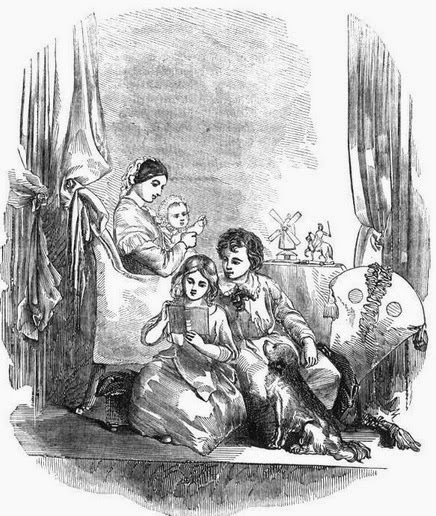 |
“The Sphere of Woman” illustration from Godey's
Lady's Book, March 1850 Found at: http://
www.assumption.edu/ whw/workshop/
untitled1.html
|
Today, women have many more rights than they did in the 19th century. Women can vote and speak publicly. Women can own property, sign contracts, and hold custody of their children. Women we call feminists, are still fighting for more equality. It is common for women to be degraded when in comparison to a man, and men are often praised while women are being put down for doing the same task. This video is a great representation of this in today's society. In comparison to conditions and expectations for women in the 1800's, women today have it easy!
Friday, January 9, 2015
Self Reliant Sourcing
“There is a time in every man's education when he arrives at the conviction that envy is ignorance; that imitation is suicide; that he must take himself for better, for worse, as his portion; that though the wide universe is full of good, no kernel of nourishing corn can come to him but through his toil bestowed on that plot of ground which is given to him to till. The power which resides in him is new in nature, and none but he knows what that is which he can do, nor does he know until he has tried.”
Ralph Waldo Emerson was a transcendentalist in the mid 19th century. He wrote "Self-Reliance" to teach people about the transcendental idea of self-reliance. Emerson wrote the essay about his beliefs during the mid 19th century. We know this is a trustworthy source because it was written during the early transcendentalism movement by a transcendentalist himself. Ideas of the Mexican and Indian War and the end of slavery were brewing at the time this essay was written. Emerson, being against slavery and war, wanted people to think for themselves, and stand up for moral decisions. This document teaches us that Transcendentalists wanted to instill trust in oneself, and personal belief. We are limited to seeing the whole of Transcendentalism by this excerpt because there were other main ideas of Transcendentalism that can be found in writings by Henry David Thoreau. Transcendentalists also believed in simple living and living deliberately. Ralph Waldo Emerson believed that everyone should accept themselves for who they are, not copy or be jealous of the lives of others. In this excerpt he states, "... envy is ignorance... imitation is suicide... he must take himself for better, for worse, as his portion." Emerson uses powerful metaphors to persuade the readers to believe his ideas.
Ralph Waldo Emerson was a transcendentalist in the mid 19th century. He wrote "Self-Reliance" to teach people about the transcendental idea of self-reliance. Emerson wrote the essay about his beliefs during the mid 19th century. We know this is a trustworthy source because it was written during the early transcendentalism movement by a transcendentalist himself. Ideas of the Mexican and Indian War and the end of slavery were brewing at the time this essay was written. Emerson, being against slavery and war, wanted people to think for themselves, and stand up for moral decisions. This document teaches us that Transcendentalists wanted to instill trust in oneself, and personal belief. We are limited to seeing the whole of Transcendentalism by this excerpt because there were other main ideas of Transcendentalism that can be found in writings by Henry David Thoreau. Transcendentalists also believed in simple living and living deliberately. Ralph Waldo Emerson believed that everyone should accept themselves for who they are, not copy or be jealous of the lives of others. In this excerpt he states, "... envy is ignorance... imitation is suicide... he must take himself for better, for worse, as his portion." Emerson uses powerful metaphors to persuade the readers to believe his ideas.
Wednesday, December 10, 2014
Are you positive Jackson's the "people's president?"
Did President Andrew Jackson really deserve the title "people's president?" Our work in class this past week proves that no, Jackson was not a president in favor of the people. In six groups we were assigned to study the Bank War, Indian Removal or The Spoils System. Only one of which supported the idea that Andrew Jackson is a "people's president."
The Bank War is the only thing we studied that supports his title. And even then there were people who did not agree that his desire to even out the power between the rich and the poor was the best for the people. My group, who focused on this topic, thought the bank war supported his title because his ultimate goal was to take away some of the power held by stockholders so that the poor people could also be able to control their economy.
Meanwhile The Indian removal and Spoils System completely deny the fact that Andrew Jackson was a "people's president." During the Indian Removal, president Jackson forced 5 innocent native tribes off of their homeland, to make room for the expansion of the United States. 10,000 natives died during their long journey to the west. Rather than seeing Jackson as a "people's president" they referred to him as the "white devil." The spoils sysytem didn't support Jackson either because he made it so that people were given jobs based on their loyalty rather than theijr skill. Criminals who supported Jackson were given jobs and sometimes even political positions. This system proved that President Jackson did not have the best interest of the people in mind and therefore we should not consider him as the "people's president."
Subscribe to:
Posts (Atom)