Slavery became economically entrenched in American society by the early 19th century. Entrenched is a word used to describe something that is firmly established or unlikely to change. Slavery was important to the harvest of crops which were used to produce goods. These goods were traded and the revenue brought in by trade boosted the economy. The economy of the United States depended on the labor of slaves, therefore it was very unlikely to abolish slavery. The cotton industry is a great example of this. As the need for cotton grew the slave population increased, because the economy depended on slave labor. In class we looked at maps that showed the corrolation between cotton production and slavery. They helped us to see how slavery became entrenched in the 19th century.
Human dignity is destroyed by systems of slavery based on race. Everyone is worthy of respect. By putting someone in slavery because of their skin color the respect is taken. In the United States those with dark skin were put into slavery. This system destroyed their dignity. It made people believe that black people were of less value than white people. It made people think it was okay to take away the rights and respect that everyone is worthy of having. Slavery based on race made people ignore valuable human characteristics. Body limits and feelings of the slaves were completely ignored. Slave owners forced slaves to work throughout the day in the hot sun. There is only so much a human body can handle but that didn't matter. If work wasn't getting done, the slaves were beaten. Abdul Raman, and African prince who was sold into slavery, refused to work and was violently beaten. Another, characteristic ignored is emotion. Slave owners ignored the feelings of their slaves. Slaves were taken from their families, and forced into doing things they didn't want to do. Abdul Raman was torn away from his royal life and thrown into a life where he was disrespected and abused. When Raman arrived at the Foster plantation, Mr. Foster shaved off his long hair which was a sign of his royalty back home. His feelings and emotional connection to his hair were ignored. Slaves in the early 19th century were deprived of dignity and their human characteristics were ignored all because their work was economically entrenched in American society.
Monday, February 23, 2015

Friday, January 30, 2015
Women are Warriors
In the mid 19th century people had many tough and some unrealistic expectations for women. Luckily, today in the society of the 21st century the expectations for women aren't not as intense. Though, there is still inequality between men and women, the work women did in the 19th century to gain equality has greatly impacted the rights women do have today.
Women had one main job in the 1800's and that was to stay at home to raise children and maintain the house. As many people know, this is not an easy task for one woman to handle all by herself. It was expected that the mother kept a quiet and relaxed home environment while she made and cleaned clothes, bared children, fixed things, cooked and cleaned. All of that had to be done in a private manner. And on top of it all, in the 19th century, as described in The Rights of Women: Laws and Practices, from the Seneca Falls Convention women could not own property, sign contracts, vote, or even claim custody over their children in the event that her spouse died. It was considered improper for women to speak in public, both verbally and in written word, therefore when women joined together at events such as the Seneca Falls convention is was rather outrageous. Women had never had a say in anything before, and all these women came together to share their opinions about equality. With hard work and dedication these women made a difference for themselves and all generations of women to come.
Today, women have many more rights than they did in the 19th century. Women can vote and speak publicly. Women can own property, sign contracts, and hold custody of their children. Women we call feminists, are still fighting for more equality. It is common for women to be degraded when in comparison to a man, and men are often praised while women are being put down for doing the same task. This video is a great representation of this in today's society. In comparison to conditions and expectations for women in the 1800's, women today have it easy!
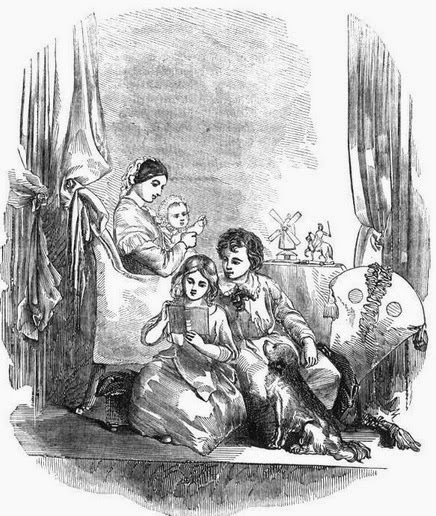 |
“The Sphere of Woman” illustration from Godey's
Lady's Book, March 1850 Found at: http://
www.assumption.edu/ whw/workshop/
untitled1.html
|
Today, women have many more rights than they did in the 19th century. Women can vote and speak publicly. Women can own property, sign contracts, and hold custody of their children. Women we call feminists, are still fighting for more equality. It is common for women to be degraded when in comparison to a man, and men are often praised while women are being put down for doing the same task. This video is a great representation of this in today's society. In comparison to conditions and expectations for women in the 1800's, women today have it easy!
Friday, January 9, 2015
Self Reliant Sourcing
“There is a time in every man's education when he arrives at the conviction that envy is ignorance; that imitation is suicide; that he must take himself for better, for worse, as his portion; that though the wide universe is full of good, no kernel of nourishing corn can come to him but through his toil bestowed on that plot of ground which is given to him to till. The power which resides in him is new in nature, and none but he knows what that is which he can do, nor does he know until he has tried.”
Ralph Waldo Emerson was a transcendentalist in the mid 19th century. He wrote "Self-Reliance" to teach people about the transcendental idea of self-reliance. Emerson wrote the essay about his beliefs during the mid 19th century. We know this is a trustworthy source because it was written during the early transcendentalism movement by a transcendentalist himself. Ideas of the Mexican and Indian War and the end of slavery were brewing at the time this essay was written. Emerson, being against slavery and war, wanted people to think for themselves, and stand up for moral decisions. This document teaches us that Transcendentalists wanted to instill trust in oneself, and personal belief. We are limited to seeing the whole of Transcendentalism by this excerpt because there were other main ideas of Transcendentalism that can be found in writings by Henry David Thoreau. Transcendentalists also believed in simple living and living deliberately. Ralph Waldo Emerson believed that everyone should accept themselves for who they are, not copy or be jealous of the lives of others. In this excerpt he states, "... envy is ignorance... imitation is suicide... he must take himself for better, for worse, as his portion." Emerson uses powerful metaphors to persuade the readers to believe his ideas.
Ralph Waldo Emerson was a transcendentalist in the mid 19th century. He wrote "Self-Reliance" to teach people about the transcendental idea of self-reliance. Emerson wrote the essay about his beliefs during the mid 19th century. We know this is a trustworthy source because it was written during the early transcendentalism movement by a transcendentalist himself. Ideas of the Mexican and Indian War and the end of slavery were brewing at the time this essay was written. Emerson, being against slavery and war, wanted people to think for themselves, and stand up for moral decisions. This document teaches us that Transcendentalists wanted to instill trust in oneself, and personal belief. We are limited to seeing the whole of Transcendentalism by this excerpt because there were other main ideas of Transcendentalism that can be found in writings by Henry David Thoreau. Transcendentalists also believed in simple living and living deliberately. Ralph Waldo Emerson believed that everyone should accept themselves for who they are, not copy or be jealous of the lives of others. In this excerpt he states, "... envy is ignorance... imitation is suicide... he must take himself for better, for worse, as his portion." Emerson uses powerful metaphors to persuade the readers to believe his ideas.
Wednesday, December 10, 2014
Are you positive Jackson's the "people's president?"
Did President Andrew Jackson really deserve the title "people's president?" Our work in class this past week proves that no, Jackson was not a president in favor of the people. In six groups we were assigned to study the Bank War, Indian Removal or The Spoils System. Only one of which supported the idea that Andrew Jackson is a "people's president."
The Bank War is the only thing we studied that supports his title. And even then there were people who did not agree that his desire to even out the power between the rich and the poor was the best for the people. My group, who focused on this topic, thought the bank war supported his title because his ultimate goal was to take away some of the power held by stockholders so that the poor people could also be able to control their economy.
Meanwhile The Indian removal and Spoils System completely deny the fact that Andrew Jackson was a "people's president." During the Indian Removal, president Jackson forced 5 innocent native tribes off of their homeland, to make room for the expansion of the United States. 10,000 natives died during their long journey to the west. Rather than seeing Jackson as a "people's president" they referred to him as the "white devil." The spoils sysytem didn't support Jackson either because he made it so that people were given jobs based on their loyalty rather than theijr skill. Criminals who supported Jackson were given jobs and sometimes even political positions. This system proved that President Jackson did not have the best interest of the people in mind and therefore we should not consider him as the "people's president."
Wednesday, December 3, 2014
Show Me Democracy!
This week we made a "Show-me" presentation about the rise of democracy in the 1800s. After viewing and analyzing many documents and primary sources, in small groups, we answered the essential question. How should we define democracy and how democratic was the US in the early 1800's?
The documents used can be found here!
http://www.edline.net/pages/Reading_HS/Classes/1415_10212102/Unit_3_-_Protecting_Nations___/Unit_3_Lesson_2_-_Democracy_
The documents used can be found here!
http://www.edline.net/pages/Reading_HS/Classes/1415_10212102/Unit_3_-_Protecting_Nations___/Unit_3_Lesson_2_-_Democracy_
Sunday, November 23, 2014
Gran Colombia Gets Independence
Why is it essential to acknowledge human value regardless of race? How are the events in the Latin American Revolutions evidence of this social imperative? The past few days in class we've been focusing on Latin American revolutions to help come up with an answer to this question. We were split into three groups and assigned a revolution; Mexico, Brazil or Gran Colombia. My group got Gran Colombia and we decided it is important to think about this question because racial inequality has been a part of the world's history for a long time, and it is important to understand this social imperative in other countries in addition to the United States.

This timeline shows the events of the Latin American revolution in Gran Colombia. In class we were briefed on the timelines for the revolutions in Brazil and Mexico. All of the revolutions ended in independence due to the strong leaders each nation had. Gran Colombia was lead by Bolivar. Mexico had Miguel Hidalgo, and Brazil had the courageous Pedro and King John VI. Another similarity that we observed is that race was an issue in all of the revolutions. For Brazil, at first Jose da Silva Xavier was killed because he did not pertain an elite status and Pedro tried to make the Portuguese the only people with power. In Mexico, Miguel called for the end of 300 years of racial inequality. Bolivar's main goal was to liberate New Granada from Spanish control in Gran Colombia. Though there many similarities seen between these revolutions there were also some differences. For example, Brazil's revolution resulted in an empire where Mexico's produced a republic. During the times of war Brazil had Portuguese monarchy that came over to rule. Gran Colombia was controlled by the dictorial powers that Bolivar managed to have over Caracas.
America is very lucky to have already gotten rid of most racial injustices. We had great leaders like Martin Luther King Junior who worked very hard during the civil rights movement to gain equality for African American people. Recently in St. Louis, Missouri, a white off duty police officer shot and killed a young black man. This is seen as a racial injustice and there have been protests throughout the city. I think it is still important to consider race in our society today so that we can prevent revolutions like those fought in Gran Colombia, Brazil and Mexico.
Wednesday, November 19, 2014
L'Ouverture's Legacy
Martin Luther King Junior is known for being one of the greatest leaders in the world's history. He pertained the qualities of honesty, moral leadership and political skill. King used these very important aspects to peacefully fight for civil rights. It is important to remember the incredible legacy King left behind. We remember Martin Luther King Junior as a civil rights leader. Though not equally as peaceful, Toussaint L'Ouverture was also a great leader. He used political skill, moral leadership and honesty to fight for the freedom of slaves in Saint Domingue during the late 1700's and early 1800's. L'Ouverture took many actions in a lot of different parts of Saint Domingue's society and government to make change. Someone who did such amazing things for a nation must be remembered. Because he did so much for Saint Domingue, in what way should Toussaint L'Ouverture be remembered? For his incredible work to change the history of the island, we remember him as a liberator of the slaves, military commander and ruler of Saint Domingue.
Toussaint L'Ouverture though he did many great things should be most remembered as a liberator of slaves. His work to free the slaves made him the courageous military commander and ruler he was. L'Ouverture's work to free the slaves had the greatest impact on Saint Domingue. The Timeline of Abolition in Saint Domingue shows that Toussaint L'Ouverture, during times of war, always fought in favor of abolishing slavery. In 1791-1792 Toussaint fought against the French and in 1794 when the French abolished slavery he fought on their side. (Doc. A) Starting in 1796 L'Ouverture again fought against the French again because they wanted to reinstate slavery. (Doc. A) This shows that Toussaint was very dedicated to freeing the slaves. In a letter to the French Directory in November 1797 L’Ouverture wrote, “ We have known how to confront danger to our liberty, and we will know to confront death to preserve it.” (Doc. B) In this quote he is threatening to fight the French if they take away the liberties that were given to the slaves. When L’Ouverture issued The Saint Domingue Constitution of 1801, he made sure one of the first articles protected the slaves. Article 3 states, “There cannot exist slaves in this territory, servitude is therein forever abolished. All men are born, live and die free and French.” (Doc. C) Because of Toussaint L’Ouverture’s endless efforts to fight against slavery, he created an incredible legacy. It is important to remember L’Ouverture as a liberator of slaves.
 |
| http://upload.wikimedia.org/wikipedia/commons/6/6f/Toussaint_L%27Ouverture.jpg |
In addition to freeing the slaves of Saint Domingue, Toussaint L’Ouverture was a military commander and for that we should remember him. His legacy includes fighting in many wars to protect the rights of slaves. During these battles, L’Ouverture proved to be a very strong leader. He proves this quality when he reacted to Moyse, a commander of the Northern Department, ordering people to kill all white plantation owners. Madison Smartt Bell in, Toussaint Louverture: A Biography, 2007 wrote, “he ordered the mutineer regiments… to step out of the ranks and blow their own brains out. . . . Toussaint ordered Moyse’s arrest....” (Doc. E) Moyse was L’Ouverture’s nephew, so the harsh punishments L’Ouverture set upon him show that he is a great military commander because he can put personal relationships aside and protect the land he loves. The people gave L’Ouverture the title, ‘heroic chief.’(Doc. F) In addition to dealing with the revolt on the Northern Plain, he took many actions to successfully drive the Spanish and English off Saint Domingue. In the excerpt, “A Description of Toussaint Louverture” from 1863, William Wells Brown wrote, “Toussaint levied fresh forces, raised the reputation of the army, and drove the English and Spanish from the island. . . .” (Doc. F) Toussaint L’Ouverture, “gained the confidence of all whom he had under his command.” (Doc. F) because he was such a great military commander and it is important to remember him as such.
Saint Domingue was successful because of the wonderful liberator of slaves and military commander the had, but what about their ruler? Toussaint L’Ouverture’s memorable legacy also includes ruling Saint Domingue. As ruler, L’Ouverture issued a constitution and a few proclamations. These orders kept control of the people, trade, government and the land. It was important to L’Ouverture to keep up the country’s prosperity even when there were no longer slaves working on plantations. As ruler he had to monitor Saint Domingue’s trade and income. In The Saint Domingue Constitution of 1801 under Title VI: Culture and Commerce, Toussaint L’Ouverture declared, “The colony being essentially agricultural cannot suffer the least disruption in the work of its cultivation. . . . Each plantation. . . shall represent the quiet haven of an active and constant family, . . .” (Doc. C) After issuing such an important document to help the success of the nation and still seeing people not working, L’Ouverture was upset. He then issued the “Proclamation, 25 November 1801.” In this proclamation he wrote, “Any individual . . . tending to incite sedition shall be brought before a court martial and be punished in conformity with the law.” (Doc. D) L’Ouverture put strong rules in place to make sure people were working, so that the country could still trade and make money. The financial success of Saint Domingue was very important to L’Ouverture. This passion is a reason why we remember Toussaint L’Ouverture as a ruler of Saint Domingue.
Although L’Ouverture is no longer alive today, it is still important we remember him, his legacy and his leadership qualities. Martin Luther King Junior, someone more commonly remember had the same leadership qualities as L’Ouverture and fought for the rights of black people during the 1950’s and 1960’s. King is remember specifically as a civil rights leader and his inspiring legacy will forever be remembered. L’Ouverture also fought for the rights of black people. His legacy is extremely important to the history of Saint Domingue. Today we remember Toussaint L’Ouverture as a liberator of slaves, military commander and ruler of Saint Domingue.
Subscribe to:
Posts (Atom)