Friday, June 12, 2015

Buffalo Soldiers

In the late 1800's the United States federal government took actions to initiate westward expansion. and colored regiments were organized. When gold was discovered in the west, colored regiments were organized to aid in moving Native Americans off of their land. The colored soldiers who were part of the regiments established went on to be called Buffalo Soldiers. These men fought many Native tribes. After viewing videos and analyzing primary sources we learned that the native troops and the colored men impacted by the new regiments were affected by the federal government's inititives for westward expansion.

Buffalo Soldiers of the 10th calvary riding horseback.
The Federal government had good intentions when they enacted policies to begin the westward expansion, but they did not think about the consequences. Their policies greatly affected the natives and buffalo soldiers. The discovery of gold in the west was predicted to greatly benefit the United States, but because there were so many tribes in the west the states had limited access to their treasure. To resolve this issue the Buffalo Soldiers moved west and moved the tribes off of their land. This way white settlers could move west and dig for gold. Helen Hunt Jackson describes how the native tribes were affected when she wrote, "There is not among these three hundred bands of Indians one which has not suffered cruelly at the hands of either the government or of white settlers. The poorer, the more insignificant, the more helpless the band, the more certain the cruelty and outrage to which they have been subjected." Natives were forced to move off of their land. They started to rebel and fought battles against the Buffalo soldiers. The buffalo soldiers worked hard to protect the white settlers, were often beaten and sometimes even shot due to the prejudice from those who they tried to protect. It was also common for these soldiers to ride 90 miles on horseback. The native americans were forced off of their land and the buffalo soldiers had to face harsh prejudice, both fought in brutal battles all because the federal government did not think of the consequences behind their good intentions.

The federal government acted selfishly. The westward expansion would benefit the United States because of the wealth that would be brought in by gold and the population increase that would come as a result of more land. What about the Native Americans who already occupied the south? Who was going to fight the native americans off of their land? The federal government acted with good intentions for themselves, but in turn affected the lives of Buffalo Soldiers and innocent western tribes.

Sources:
http://www.pbslearningmedia.org/resource/49e8d07f-313d-44af-924a-591b0c96aeea/buffalo-soldiers-in-new-mexico/ 

"Helen Hunt Jackson: A Century of Dishonor (1881)." American History. ABC-CLIO, 2015. Web. 5 June 
2015. 

http://www.nps.gov/prsf/learn/historyculture/buffalo-soldiers.htm


Thursday, June 4, 2015

Good vs Evil


      The steel industry exploded in the early 1900s. During this times the United States produced the largest amount of the world's steel and oil. John D Rockefeller and Andrew Carnegie are two of America's richest people who arose from this industrial innovation period. They are still admired today for their work, but in the 1900s should they be considered robber barons or captains of industry?
 
     Both robber barons and captains of industry were popping up more and more during this time. Captains of industry are leaders who believe in competiton and are liked by others. On the contrary robber barons were not liked by others and rather than natural competition they wanted to destroy their rivals. By these definitions I would classify John D Rockefeller as a robber baron and Andrew Carnegie as a captain of industry.
 
  John D Rockefeller was a leader in the oil industry, who was said to be "mad for oil." He used his position as a major personnel in oil production to bring in a lot of wealth. One of his main goals was to make money. He said, "Someday I will be the richest man in the world." With his money he did not compete with other oil businesses, he rather bought out the companies that were not doing well. In addition to this he bribed politicians and used horizontal integration. Horizontal integration is the practice of meeting with other companies' directors to make sure their prices stay high. Because Rockefeller followed these tactics and was not liked by others, he should be classified as a robber baron.
 
     Andrew Carnegie was very different than Rockefeller. Although, they both were top businessmen in their class Carnegie is a captain of industry. Carnegie excelled in the steel business and became very wealthy. He believed in the "gospel of wealth," the idea that every rich man was made rich by god and he has the duty to use his wealth for the good of the people. Carnegie most definitely used his wealth for the good of others. He founded Carnegie Mellon University and spent excess money on public needs such as education and libraries. In addition to this Andrew Carnegie was a believer in rewarding his workers and recognizing their talent. Carnegie proved to be a "people person" and should be classified as a captain of industry.
 
Images:

Monday, April 27, 2015

Power from Above

In class we have been learning about the events leading up to the abolition of slavery. A major point of this lesson was to determine if the acts of freedom were granted by powers from above or below. Power from above is change made by someone in authority, often a reaction to the slaves. Power from below is just the opposite. It is when a group of people without power create change.

In terms of the civil war and abolition of slavery, this change was granted by power from above. When Union troops moved through Southern cities the slaves would flock in. The slaves crowded the city streets enough to make the troops complain to higher powers. These complaints made their way to the president and from there he spoke the emancipation proclamation. This stated that slaves in rebelling states were free. Later on the 13th amendment was declared by congress. From this slavery was abolished.

Although power from above was used in the civil war, I do not believe that it is the only way to achieve things. People when they come together have the power to accomplish great things.


Monday, April 6, 2015

Civil War Scavenger Hunt

This previous week in history class, we participated in a civil war battle scavenger hunt. We were given a list with short summaries of the civil war battles, from there we chose one of the descriptions and had to research the information we were given to name to battle. Next, we made a google document with the name of the battle, it's theater (east,west, or naval), the victor and the reasons for their success. We made a QR code to direct our classmates to the document. These QR codes were hidden around the school, each with a clue to where the next code was located. While hunting around our school we took notes on the documents and answered the questions, Who was the ultimate victor in each of the theaters of war: East, West, naval? And What are some commonalities identifying the reasons for the results of the battles?

I found that in the Eastern theater the confederate states were the primary victors. A majority of the battles were won by them including the battles of  the bull run, Fredericksburg, Chancellorsville, and Cold Harbor. In the Eastern battles the union proved to have a lack of reinforcement where the confederacy had strong initial counter attacks. Although the Confederacy was able to dominate in the East the union was champion in the western theater. The union won the battles of Fort Henry, Shiloh, Fort Donelson, Vicksburg and many more. In the eastern theater the union was able to outnumber the confederacy and they proven to have a superior strategy. In accordance with the naval theater, the union was again the victor. The confederate armies had outdated weaponry compared to the union armies. The union had previously developed naval army and therefore their naval forces were stronger than the confederate's. The union's superior navy aided them into victory of the battles of Fort Henry, Fort Donelson, Hampton Roads, and Baton Rouge,

This activity, though tiring, was very fun! It was a good break from what we usually do in class, and it helped wake me up in the morning. I enjoyed being able to work together with my classmates to create the scavenger hunt and still being able to enjoy it myself.

Here is a padlet my class made today in class to show who the victor was in each of the civil war theaters.


Tuesday, March 17, 2015

Civil War in Art

The essential question asked to us this week was, How were the results of the Election of 1860 representative of the deep divisions over slavery? This answer has many aspects one being that when Lincoln became president the southern states who were not in favor of his presidency felt the urge to leave the union. We looked at many pieces of art from the civil war which also helped show the election of 1860 and secession. Check out the art in my group's Educreations video!


Tuesday, March 10, 2015

Union vs Confederacy

      We have been learning about the events leading up to the civil war in class recently.After viewing many documents and statistics it became evident that the North would win the war. Though the south had many advantages such as trained military personnel, a large slave population for fighting, and a good income due to trade, the advantages the North had out weighed those of the South. For this reason I set up my info graphic based on Northern advantages. My project displays a variety of interesting important data to prove that the North was truly on top during the Civil War.

Monday, March 2, 2015

Elephant in the Room


Slavery, an uneasy topic for many, has proven to be the elephant in the room for 19th century politics. By creating a timeline of events that led up to the civil war in class this week we learned a lot about how slavery was the elephant in the room. This means that slavery was a major issue that people avoided having discussions about. Though Politicians in the 19th century did have meetings like the one at which the Compromise of 1850 was declared, people tried to avoid talking about slavery. They took action for whichever side they supported, either anti or pro slavery. Events such as Bleeding Kanas, The Canning of Charles Sumner, and John Brown's Raid all ended in violence simply because slavery was the elephant in the room and no one wanted to talk about it.


Henry Clay
In 1850 California requested to join the union as free state. Henry Clay anticipated the anticipated the controversy that would be caused by having an uneven number of slave and free states so he proposed the compromise of 1850. This compromise was made up of 5 agreements that would temporarily keep peace between both parties. Part one declared that in exchange for $10 million Texas had to give up Santa Fe. In part two it was decided that New Mexico, Arizona, Utah, and Nevada were to be organized without mention of slavery. Whether the territories would be free or not was to be determined by the majority in the population when those areas applied for state hood. People supporting pro slavery were especially happy with this because all they had to do was move pro slavery families on to this new land.  Part three wasn't as appealing to them though. The third part stated that slave trade was abolished in Washington D.C. Slavery was still permitted. Pro slavery groups had nothing to worry about. Parts four and five were in their favor. Part four made it so that California was a free state and part five tells us that the fugitive slave act was passed. This act made it so that slaves were brought in front of magistrates instead of having a fair trial. It also stated that is you saw a runaway slave, in accordance with the law, you had to turn them in. The compromise of 1850 is seen as a catalyst to many events following that all lead up to the civil war.

Slavery, being the elephant in the room, caused the violent actions were refer to as Bleeding Kansas. This is a few events grouped together in a broader unit. Some of these events include the burning of Lawrence and the massacre at Pottawatomie Creek. Lawrence Kansas, home to a popular newspaper, was burned on May 21, 1856 by a pro slavery mob. There goal was to prohibit the spread of anti slavery by word. Three days later, John Brown massacred many men at Pottawatomie Creek. All this violence was a result of people not wanting to sit down and discuss the obvious issue at hand.

The Canning of Charles Sumner is the next violent outbreak that occurred. Charles Sumner was the senator of Massachusetts and a leading republican with a powerful voice for anti slavery. In his fiery speech, "The Crime Against Kansas" he made direct remarks towards about South Carolina's senator, Andrew Butler. Butler's nephew, Preston Brooks was upset that Sumner bashed his uncle so he brutally beat Sumner with his cane. Cane never fully recovered, and Brooks received praise from the south for his actions.

John Brown's raid was another extremely violent event that happened during the 19th century.  October 16, 1859 Brown and 21 other men, a mixed of whites and blacks, raided the federal arsenal at Harper's Ferry. John Brown was quickly injured and captures. He was later hanged on December 2.

Bleeding Kansas, The canning of Charles Sumner, and John Brown's raid are all evidence that slavery was the elephant in the room for American politics in the early 19th century. If people had been more willing to discuss the evident issue of slavery, many violent acts could've been avoided.


http://en.wikipedia.org/wiki/Henry_Clay

Monday, February 23, 2015

Dignity Destroyed

     Slavery became economically entrenched in American society by the early 19th century. Entrenched is a word used to describe something that is firmly established or unlikely to change. Slavery was important to the harvest of crops which were used to produce goods. These goods were traded and the revenue brought in by trade boosted the economy. The economy of the United States depended on the labor of slaves, therefore it was very unlikely to abolish slavery. The cotton industry is a great example of this. As the need for cotton grew the slave population increased, because the economy depended on slave labor. In class we looked at maps that showed the corrolation between cotton production and slavery. They helped us to see how slavery became entrenched in the 19th century.

     Human dignity is destroyed by systems of slavery based on race. Everyone is worthy of respect. By putting someone in slavery because of their skin color the respect is taken. In the United States those with dark skin were put into slavery. This system destroyed their dignity. It made people believe that black people were of less value than white people. It made people think it was okay to take away the rights and respect that everyone is worthy of having. Slavery based on race made people ignore valuable human characteristics. Body limits and feelings of the slaves were completely ignored. Slave owners forced slaves to work throughout the day in the hot sun. There is only so much a human body can handle but that didn't matter. If work wasn't getting done, the slaves were beaten. Abdul Raman, and African prince who was sold into slavery, refused to work and was violently beaten. Another, characteristic ignored is emotion. Slave owners ignored the feelings of their slaves. Slaves were taken from their families, and forced into doing things they didn't want to do. Abdul Raman was torn away from his royal life and thrown into a life where he was disrespected and abused. When Raman arrived at the Foster plantation, Mr. Foster shaved off his long hair which was a sign of his royalty back home. His feelings and emotional connection to his hair were ignored. Slaves in the early 19th century were deprived of dignity and their human characteristics were ignored all because their work was economically entrenched in American society.

Friday, January 30, 2015

Women are Warriors

In the mid 19th century people had many tough and some unrealistic expectations for women. Luckily, today in the society of the 21st century the expectations for women aren't not as intense. Though, there is still inequality between men and women, the work women did in the 19th century to gain equality has greatly impacted the rights women do have today.

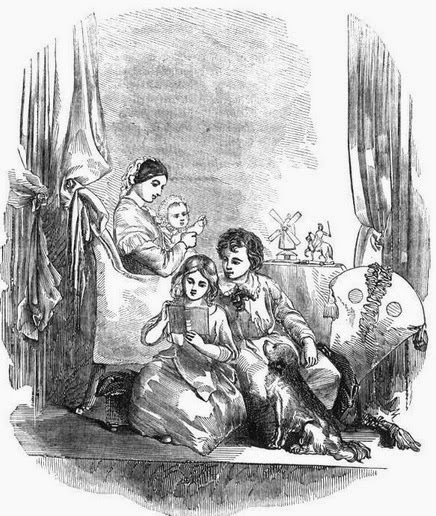
“The Sphere of Woman” illustration from Godey's 
Lady's Book, March 1850 Found at: http:// 
www.assumption.edu/ whw/workshop/ 
untitled1.html 
Women had one main job in the 1800's and that was to stay at home to raise children and maintain the house. As many people know, this is not an easy task for one woman to handle all by herself. It was expected that the mother kept a quiet and relaxed home environment while she made and cleaned clothes, bared children, fixed things, cooked and cleaned. All of that had to be done in a private manner. And on top of it all, in the 19th century, as described in The Rights of Women: Laws and Practices, from the Seneca Falls Convention women could not own property, sign contracts, vote, or even claim custody over their children in the event that her spouse died. It was considered improper for women to speak in public, both verbally and in written word, therefore when women joined together at events such as the Seneca Falls convention is was rather outrageous. Women had never had a say in anything before, and all these women came together to share their opinions about equality. With hard work and dedication these women made a difference for themselves and all generations of women to come.

Today, women have many more rights than they did in the 19th century. Women can vote and speak publicly. Women can own property, sign contracts, and hold custody of their children. Women we call feminists, are still fighting for more equality. It is common for women to be degraded when in comparison to a man, and men are often praised while women are being put down for doing the same task. This video is a great representation of this in today's society. In comparison to conditions and expectations for women in the 1800's, women today have it easy!

Friday, January 9, 2015

Self Reliant Sourcing

“There is a time in every man's education when he arrives at the conviction that envy is ignorance; that imitation is suicide; that he must take himself for better, for worse, as his portion; that though the wide universe is full of good, no kernel of nourishing corn can come to him but through his toil bestowed on that plot of ground which is given to him to till. The power which resides in him is new in nature, and none but he knows what that is which he can do, nor does he know until he has tried.” 

Ralph Waldo Emerson was a transcendentalist in the mid 19th century. He wrote "Self-Reliance" to teach people about the transcendental idea of self-reliance. Emerson wrote the essay about his beliefs during the mid 19th century. We know this is a trustworthy source because it was written during the early transcendentalism movement by a transcendentalist himself. Ideas of the Mexican and Indian War and the end of slavery were brewing at the time this essay was written. Emerson, being against slavery and war, wanted people to think for themselves, and stand up for moral decisions. This document teaches us that Transcendentalists wanted to instill trust in oneself, and personal belief. We are limited to seeing the whole of Transcendentalism by this excerpt because there were other main ideas of Transcendentalism that can be found in writings by Henry David Thoreau. Transcendentalists also believed in simple living and living deliberately. Ralph Waldo Emerson believed that everyone should accept themselves for who they are, not copy or be jealous of the lives of others. In this excerpt he states, "... envy is ignorance... imitation is suicide... he must take himself  for better, for worse, as his portion." Emerson uses powerful metaphors to persuade the readers to believe his ideas. 
  • Waldo Emerson, Ralph. "Self-Reliance Quotes." By Ralph Waldo Emerson. Accessed January 9, 2015. http://www.goodreads.com/work/quotes/1758578-self-reliance.


Wednesday, December 10, 2014

Are you positive Jackson's the "people's president?"

Did President Andrew Jackson really deserve the title "people's president?" Our work in class this past week proves that no, Jackson was not a president in favor of the people. In six groups we were assigned to study the Bank War, Indian Removal or The Spoils System. Only one of which supported the idea that Andrew Jackson is a "people's president." 


The Bank War is the only thing we studied that supports his title. And even then there were people who did not agree that his desire to even out the power between the rich and the poor was the best for the people. My group, who focused on this topic, thought the bank war supported his title because his ultimate goal was to take away some of the power held by stockholders so that the poor people could also be able to control their economy.

 Meanwhile The Indian removal and Spoils System completely deny the fact that Andrew Jackson was a "people's president." During the Indian Removal, president Jackson forced 5 innocent native tribes off of their homeland, to make room for the expansion of the United States. 10,000 natives died during their long journey to the west. Rather than seeing Jackson as a "people's president" they referred to him as the "white devil." The spoils sysytem didn't support Jackson either because he made it so that people were given jobs based on their loyalty rather than theijr skill. Criminals who supported Jackson were given jobs  and sometimes even political positions. This system proved that President Jackson did not have the best interest of the people in mind and therefore we should not consider him as the "people's president." 


Wednesday, December 3, 2014

Show Me Democracy!

This week we made a "Show-me" presentation about the rise of democracy in the 1800s. After viewing and analyzing many documents and primary sources, in small groups, we answered the essential question. How should we define democracy and how democratic was the US in the early 1800's?

The documents used can be found here!

http://www.edline.net/pages/Reading_HS/Classes/1415_10212102/Unit_3_-_Protecting_Nations___/Unit_3_Lesson_2_-_Democracy_

Sunday, November 23, 2014

Gran Colombia Gets Independence


     Why is it essential to acknowledge human value regardless of race? How are the events in the Latin American Revolutions evidence of this social imperative? The past few days in class we've been focusing on Latin American revolutions to help come up with an answer to this question. We were split into three groups and assigned a revolution; Mexico, Brazil or Gran Colombia. My group got Gran Colombia and we decided it is important to think about this question because racial inequality has been a part of the world's history for a long time, and it is important to understand this social imperative in other countries in addition to the United States. 

     
     This timeline shows the events of the Latin American revolution in Gran Colombia. In class we were briefed on the timelines for the revolutions in Brazil and Mexico. All of the revolutions ended in independence due to the strong leaders each nation had. Gran Colombia was lead by Bolivar. Mexico had Miguel Hidalgo, and Brazil had the courageous Pedro and King John VI. Another similarity that we observed is that race was an issue in all of the revolutions. For Brazil, at first Jose da Silva Xavier was killed because he did not pertain an elite status and Pedro tried to make the Portuguese the only people with power. In Mexico, Miguel called for the end of 300 years of racial inequality. Bolivar's main goal was to liberate New Granada from Spanish control in Gran Colombia. Though there many similarities seen between these revolutions there were also some differences. For example, Brazil's revolution resulted in an empire where Mexico's produced a republic. During the times of war Brazil had Portuguese monarchy that came over to rule. Gran Colombia was controlled by the dictorial powers that Bolivar managed to have over Caracas. 

     America is very lucky to have already gotten rid of most racial injustices. We had great leaders like Martin Luther King Junior who worked very hard during the civil rights movement to gain equality for African American people. Recently in St. Louis, Missouri, a white off duty police officer shot and killed a young black man. This is seen as a racial injustice and there have been protests throughout the city. I think it is still important to consider race in our society today so that we can prevent revolutions like those fought in Gran Colombia, Brazil and Mexico. 

Wednesday, November 19, 2014

L'Ouverture's Legacy


Martin Luther King Junior is known for being one of the greatest leaders in the world's history. He pertained the qualities of honesty, moral leadership and political skill. King used these very important aspects to peacefully fight for civil rights. It is important to remember the incredible legacy King left behind. We remember Martin Luther King Junior as a civil rights leader. Though not equally as peaceful, Toussaint L'Ouverture was also a great leader. He used political skill, moral leadership and honesty to fight for the freedom of slaves in Saint Domingue during the late 1700's and early 1800's. L'Ouverture took many actions in a lot of different parts of Saint Domingue's society and government to make change. Someone who did such amazing things for a nation must be remembered. Because he did so much for Saint Domingue, in what way should Toussaint L'Ouverture be remembered? For his incredible work to change the history of the island, we remember him as a liberator of the slaves, military commander and ruler of Saint Domingue.

    Toussaint L'Ouverture though he did many great things should be most remembered as a liberator of slaves. His work to free the slaves made him the courageous military commander and ruler he was. L'Ouverture's work to free the slaves had the greatest impact on Saint Domingue. The Timeline of Abolition in Saint Domingue shows that Toussaint L'Ouverture, during times of war, always fought in favor of abolishing slavery. In 1791-1792 Toussaint fought against the French and in 1794 when the French abolished slavery he fought on their side. (Doc. A) Starting in 1796 L'Ouverture again fought against the French again because they wanted to reinstate slavery. (Doc. A) This shows that Toussaint was very dedicated to freeing the slaves. In a letter to the French Directory in November 1797 L’Ouverture wrote, “ We have known how to confront danger to our liberty, and we will know to confront death to preserve it.” (Doc. B) In this quote he is threatening to fight the French if they take away the liberties that were given to the slaves. When L’Ouverture issued The Saint Domingue Constitution of 1801, he made sure one of the first articles protected the slaves. Article 3 states, “There cannot exist slaves in this territory, servitude is therein forever abolished. All men are born, live and die free and French.” (Doc. C) Because of Toussaint L’Ouverture’s endless efforts to fight against slavery, he created an incredible legacy. It is important to remember L’Ouverture as a liberator of slaves.

http://upload.wikimedia.org/wikipedia/commons/6/6f/Toussaint_L%27Ouverture.jpg
    In addition to freeing the slaves of Saint Domingue, Toussaint L’Ouverture was a military commander and for that we should remember him. His legacy includes fighting in many wars to protect the rights of slaves. During these battles, L’Ouverture proved to be a very strong leader. He proves this quality when he reacted to Moyse, a commander of the Northern Department, ordering people to kill all white plantation owners. Madison Smartt Bell in, Toussaint Louverture: A Biography, 2007 wrote, “he ordered the mutineer regiments… to step out of the ranks and blow their own brains out. . . . Toussaint ordered Moyse’s arrest....” (Doc. E) Moyse was L’Ouverture’s nephew, so the harsh punishments L’Ouverture set upon him show that he is a great military commander because he can put personal relationships aside and protect the land he loves. The people gave L’Ouverture the title, ‘heroic chief.’(Doc. F) In addition to dealing with the revolt on the Northern Plain, he took many actions to successfully drive the Spanish and English off Saint Domingue. In the excerpt, “A Description of Toussaint Louverture” from 1863, William Wells Brown wrote, “Toussaint levied fresh forces, raised the reputation of the army, and drove the English and Spanish from the island. . . .” (Doc. F) Toussaint L’Ouverture, “gained the confidence of all whom he had under his command.” (Doc. F) because he was such a great military commander and it is important to remember him as such.

    Saint Domingue was successful because of the wonderful liberator of slaves and military commander the had, but what about their ruler? Toussaint L’Ouverture’s memorable legacy also includes ruling Saint Domingue. As ruler, L’Ouverture issued a constitution and a few proclamations. These orders kept control of the people, trade, government and the land. It was important to L’Ouverture to keep up the country’s prosperity even when there were no longer slaves working on plantations. As ruler he had to monitor Saint Domingue’s trade and income. In The Saint Domingue Constitution of 1801 under Title VI: Culture and Commerce, Toussaint L’Ouverture declared, “The colony being essentially agricultural cannot suffer the least disruption in the work of its cultivation. . . . Each plantation. . . shall represent the quiet haven of an active and constant family, . . .” (Doc. C) After issuing such an important document to help the success of the nation and still seeing people not working, L’Ouverture was upset. He then issued the “Proclamation, 25 November 1801.” In this proclamation he wrote, “Any individual . . . tending to incite sedition shall be brought before a court martial and be punished in conformity with the law.” (Doc. D) L’Ouverture put strong rules in place to make sure people were working, so that the country could still trade and make money. The financial success of Saint Domingue was very important to L’Ouverture. This passion is a reason why we remember Toussaint L’Ouverture as a ruler of Saint Domingue.

Although L’Ouverture is no longer alive today, it is still important we remember him, his legacy and his leadership qualities. Martin Luther King Junior, someone more commonly remember had the same leadership qualities as L’Ouverture and fought for the rights of black people during the 1950’s and 1960’s. King is remember specifically as a civil rights leader and his inspiring legacy will forever be remembered. L’Ouverture also fought for the rights of black people. His legacy is extremely important to the history of Saint Domingue. Today we remember Toussaint L’Ouverture as a liberator of slaves, military commander and ruler of Saint Domingue.

Wednesday, November 5, 2014

Is France a Failure?


     Were the revolutions of 1830 and 1848 really failures as many historians have concluded? During 1830 and 1848 revolts were a trend throughout Europe, all for various reasons. To learn about these breakouts our class was split into groups and then assigned a revolt. We read primary sources to teach us about these rebellions and created short quizzes for the other groups to take. We used our devices to make quizzes on the app, Survey Monkey. By reading the primary sources and taking the quizzes we learned that not all the revolts were highly successful, but should they be considered a failure?

     My group focused on the France 1830 revolt. The French rebels wanted to remove Charles X from power. His ideas of absolutism were not admired. The rebels were also not fond of Charles X's decision to limit the rights of the press. In the "July Ordinances" Charles wrote, "The liberty of the periodical press is suspended." The rebels were upset that their rights were being taken away and wanted a ruler who was for the people. After taking over the streets of Paris the rebels got what they wanted. Charles X abdicated the crown and fled to England. The "Orleanist Manifesto" declared, "Charles X can no longer return to Paris... The Duke of Orleans is a citizen king," The Duke of Orleans, Louis Phillipe, was for the people. In this revolt the rebels got what they wanted. Charles X was removed from power and they got their rights restored by Louis Phillipe. Though the French people did not gain full freedom they still were partially successful. The France 1830 revolt should most definitely not be considered a failure.

Check out my group's survey!
https://www.surveymonkey.com/s/T7WPJNT


     The France 1830 revolt was successful, but what about the other revolts of 1830 and 1848? Is it fair to say that the revolutions of 1830 and 1848 were failures? I believe that these revolutions were not failures. Though they were not all fully successful or like the Decembrist revolt not successful at all, as a whole the revolutions of 1830 and 1848 were not a failure. The France 1848 revolt was partly successful. The rebels were able to get the extended suffrage that they wanted, but only wealthy people were able to vote. This is not a failure. Though not everyone was pleased the rebels were able to get what they wanted. The revolt of the Frankfurt Assembly was only partially negative. Many people were put in jail as a result of this revolt, but no change was made. It was not a complete failure in the sense that their conditions didn't get worse than they were before the revolution and they didn't have rights taken away from them. This revolution had a few negatives, but it was not a complete failure, therefore this is another revolt that would not contribute to the revolts of 1830 and 1848 being a failure. One last revolt that supports this idea is the 1848 Hungary revolt. This revolt was neutrally good and bad. The Hungarians were able to get rid of Metternich, but in the end their revolutionary leaders fled Hungary. Only one revolt in the revolts of 1830 and 1848 can be classified as a complete failure. I do no agree that the revolts of 1830 and 1848 that happened across Europe are failures.

Tuesday, October 28, 2014

Power to the People... and Louis XVIII


What should people in power do when their power is threatened? What should people in power do when Napoleon conquers Europe? The Congress of Vienna was created to help solve problems brought up by Napoleon Bonaparte’s European conquests. The congress played an important role in returning power back to those who had their powers threatened. In class we did a group activity on padlet.com, where we read a background essay and chose a solution to various problems the Congress of Vienna had to face.

Klemens von Metternich was one of many powerful people at the congress of vienna. He along with the other leaders came up with the principle of legitimacy. This principle restored the power in lawful monarchs. The charter of 1814 was put in place to make France a constitutional monarchy in which all French people were equal before the law. This allowed all people to practice any religion freely. Power was reestablished within the Bourbon monarchy, allowing Louis XVIII to rule,  but there was still more equality and power for the French people.

The decision to restore the throne to Louis XVIII was a good choice for the success of France. I think it was good idea because it allowed France to go back to a system of government that they were familiar with. This gave them the opportunity to rebuild their society rather quickly. I feel that that was a smart decision because France had a boost of confidence and strength.

Tuesday, October 21, 2014

Ideologies Genius

Conservatism, liberalism, and national are three major ideologies. Conservatism is the idea that change in the current systems is bad. Liberalism supports individual liberties and nationalism focuses in uniting nations based on history, culture, and language. All three of these ideologies played an important role in the political and social systems of Europe in the 19th century.

To learn about these ideologies, in small groups we created a one minute project to teach the class about an assigned topic. After it was declared that my group would study nationalism, we made a video. In the one minute film, as I walk down the hall, I come across an "ideologies genius" who wants to tell me all about nationalism in the 19th century. He teaches me that nationalism is the idea that a nation is grouped by language, culture, and history. Nationalism helped people rebuild after the French Revolution. It also made Italy and France realize that if they hadn't been so separated and been more united like a nation then Napoleon wouldn't have been able to defeat them so easily.  Nationalism affected Europe socially and politically.

Nationalism wasn't the only thing that affected Europe's social and political systems. Liberalism, the idea that all people had their own god given rights also impacted these aspects of 19th century Europe. Liberals believed in a meritocracy, a system in which people were awarded by their skill rather than their class. This system would put monarchy out of power and give more power to the talented poor people. Conservatism on the other hand, wanted to keep the power within the church and monarchy. Conservative people were afraid of a possible revolution due to change, so they did not support innovation and reform. In addition to nationalism, conservatism and liberalism impacted the social and political systems of 19th century Europe.h

Monday, October 13, 2014

The Bold and Brave Bonaparte


In the early 1800's Europe was majorly affected by a very powerful man. This extraordinary military leader is commonly known for "his untiring industry, his devotion to the public service, his enlightened views of government and legislation, his humanity." Napoleon Bonaparte, said to be "the greatest genius of his time," had a great influence on the economic, social, and political systems of Europe.  

Politically, Napoleon had both positive and negative impacts on Europe. He was able to overthrow the directory and he was powerful enough to take over many countries, but he became an emperor. Rulers and people like Madame de Staël, who came from families connected to monarchy were not fond of Napoleon. Napoleon took power away from them when he became an emperor and they were forced to follow the Napoleonic code. Madame de Staël claimed Napoleon's goal was to "encroach daily upon France's liberty and Europe's freedom." Though there were clearly people who didn't favor Napoleon, people in the countries he controlled did benefit from his rule.

Napoleon's economic impact was especially positive on France. He strongly encouraged new industry. He built many new railroads and canals. With this increased industry, France was given the opportunity to trade with all the other countries Napoleon ruled over. Impacts like this contribute to why Marshal Michel Ney, an officer who served closely with Napoleon, referred to him as France's "august emperor."

Under Napoleon's rule, people were able to improve their own lives. Napoleon impacted the social system of Europe by creating a meritocracy. A meritocracy is a system in which people are rewarded by skill rather than social class. Napoleon made it so that more people had rights to their own property and access to education. This was seen as a positive impact on the social systems of a Europe.


http://www.napoleon­series.org/research/biographies/c_historians.html
http://www.greatthoughtstreasury.com/author/napoleon-bonaparte-napoleon-i
Ten Years of Exile, by Madame de Staël, trans. Doris Beik (Saturday Review Press, 1972)
The French Revolution and Napoleon: An Eyewitness History, by Joe H. Kirchberger (Facts on File, 1985).


Tuesday, October 7, 2014

Rock, Paper, Socialism, Shoot!

The classic game Rock, Paper, Scissors, can be used in more ways than just a game to play when you're bored or a way to break a tie. In class we played this fun, interactive game to simulate communism, capitalism, and socialism. Adding chocolate to the game made it even better! This class was exciting yet frustrating at the same time. I hated losing my chocolate when I lost a round of the game. I can only imagine how people felt having to give up some of their wealth when faced with capitalism, communism, and socialism in real life.

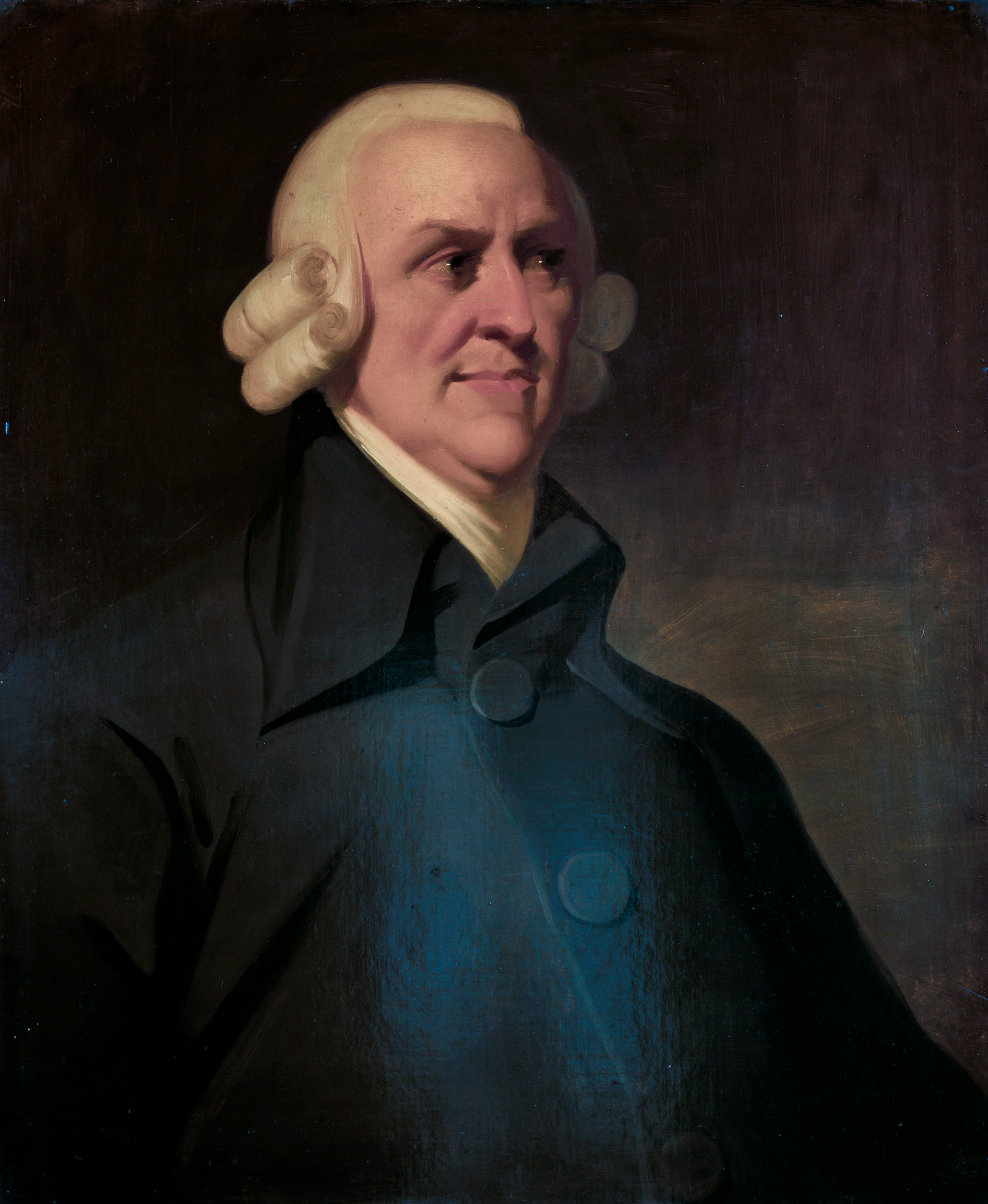
Karl Marx and Adam Smith both wanted to help the poor, but they had very different approaches on how to do so. Marx came up with theories in which the poor would help themselves. We call these ideas communism, socialism, and capitalism. In communism, there would be no government needed. Everyone would share the resources. Therefore, the poor could have access to the same things the wealthy did. With socialism, there would be economic equality and a classless society. Each citizen would start with the same amount of wealth. The poor people would have an equal amount to the rich people. And lastly, there's capitalism, in which there is freedom of competition and unequal economic classes. With this system, the poor would truly have to fight for themselves. Adam Smith's theory of the invisible hand helped the poor in a very different way. Smith believed in a government that let the market naturally take care of itself. This would allow higher quality goods to be sold at lower prices due to competition between companies. The invisible hand initiates the changes. Poor citizens could buy good products at an affordable cost.

I personally believe that Adam Smith's theory is best. Industrialists are allowed to be in control of their own businesses. Under this system people can choose what they want to buy and sell. Higher quality products could be sold at more affordable prices. Opposed to Marx's theories the wealthy people could continue to be wealthy, but the poor people are given opportunities to catch up and prosper. This theory  seems to please many social groups. This is a good system because it seems to please many social groups.

http://a2.files.biography.com/image/upload/c_fill,dpr_1.0,g_face,h_300,q_80,w_300/MTE1ODA0OTcxNzE5NjI0MjA1.jpg
http://upload.wikimedia.org/wikipedia/commons/4/43/Adam_Smith_The_Muir_portrait.jpg


Monday, September 29, 2014

The Ups and Downs of Life at the Mills

     Young women and girls from across America begged their parents for permission to go to cities like Lowell Massachusetts to become mill girls. Some stories describe horrid accidents and terrible living and working conditions caused by the mills, so why would anyone want to work there?

     Farming was a major source of income during this time. It was often a struggle to produce a good harvest, therefore there was a very small income. Every extra amount of money helped. Mill workers could earn up to six dollars per month. Families were attracted to this wage because their daughters could send money home. The girls themselves liked the thought of this because after paying boarding dues and sending money home they still had a tiny bit of spending money for things like new shoes and dresses. Another reason young women were attracted to the life of a mill worker was because that had the opportunity to "see the world." The girls felt as though they had more independence in the city than they'd have at home on the farm with their fathers. The mill life appealed to many girls because of the money and freedom. 

     The girls who thought it would be a great idea to leave home may have changed their minds after working in the mills for a little while. Though there were great benefits, there was also some costs to the lifestyle they chose. The girls worked long, tiring hours in the dangerous mills where they put their health and safety on the line everyday. When they returned to the boarding house for the night, they were to follow very strict rules. Life at the mills wasn't always as wonderful as the girls assumed it would be.

     The life of a mill girl had it's ups and downs, but their work helped change the attitude people had towards women in the 1800's. After many girls bravely left home at a young age to work, people no longer thought girls were meant to stay at home with their fathers until marriage. After the girls boycotted for increased wages they had more of a political position in society. People in the 1800's started to see women as the brave, strong, and independent people they truly are.